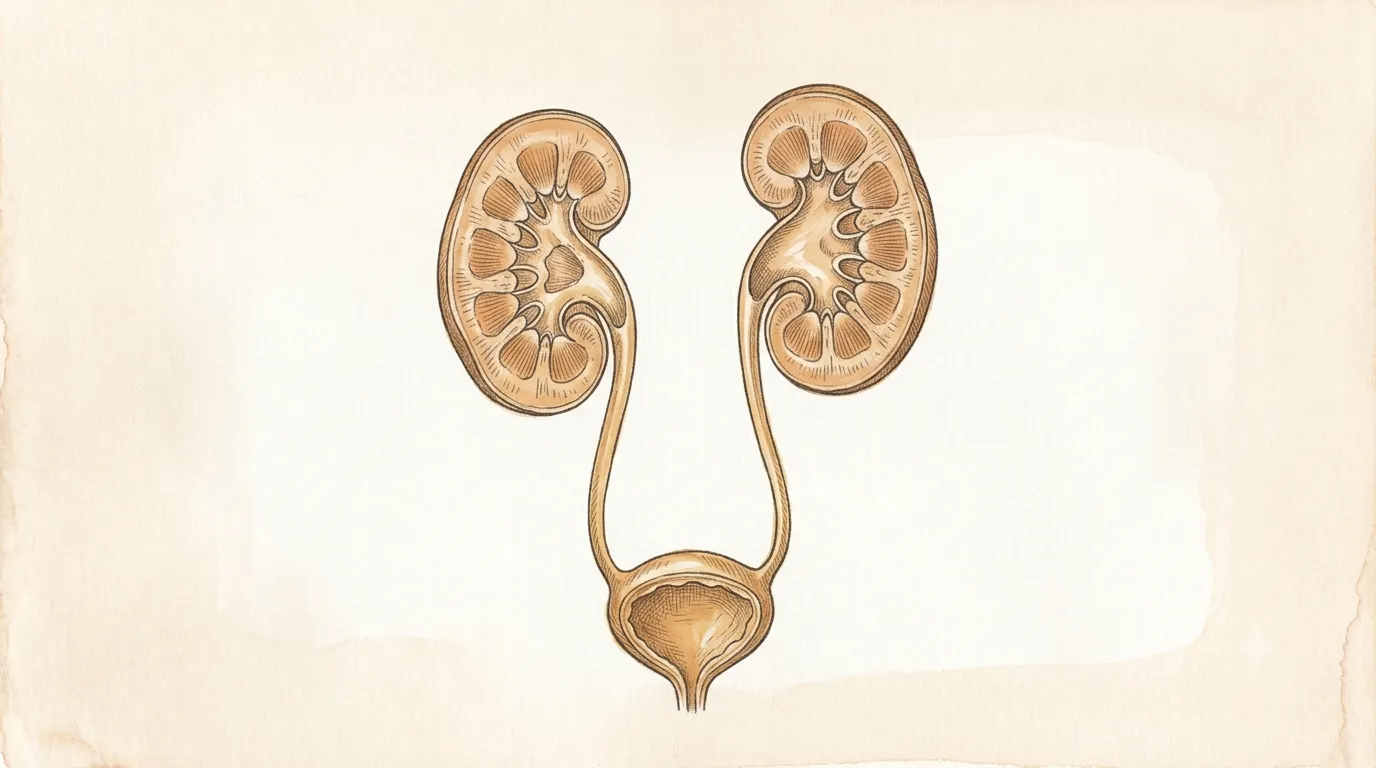
They reclaim almost everything they filter — only about 1–2 L leaves the body as urine.
Urinary System
Kidneys
RenesThe master filters
Filters blood and forms urine
Paired filtration organs that balance fluids, electrolytes, blood pressure, and waste removal.
- Renal CortexOuter filtering layer
- Renal CapsuleFibrous shell — stretching it is what causes pain
- Renal MedullaConcentrates urine
- Renal PyramidWedge of collecting tubules pointing inward
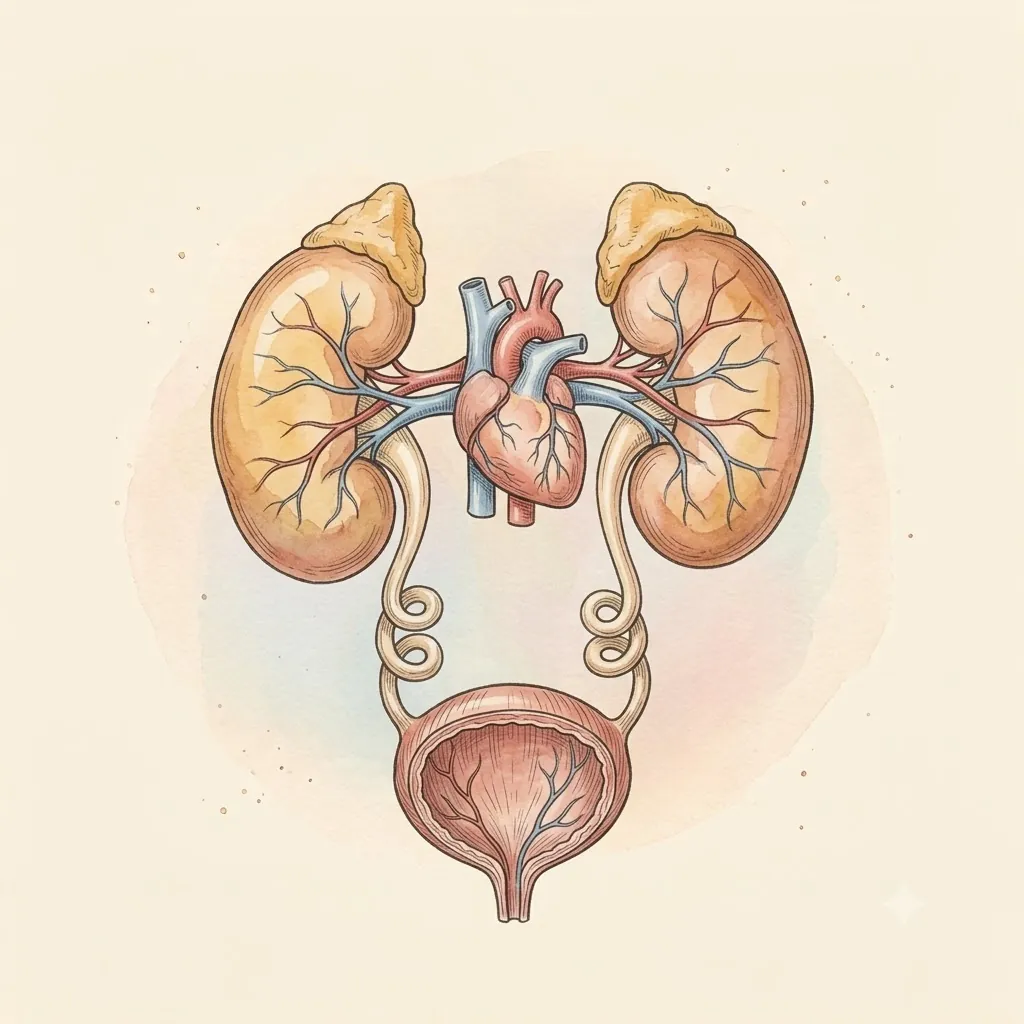
- Renal ArteryDelivers a fifth of the heart's output
- Renal VeinReturns filtered blood to the vena cava
- Renal PelvisFunnels urine toward the ureter
- Adrenal GlandEndocrine gland riding on top, unrelated in function
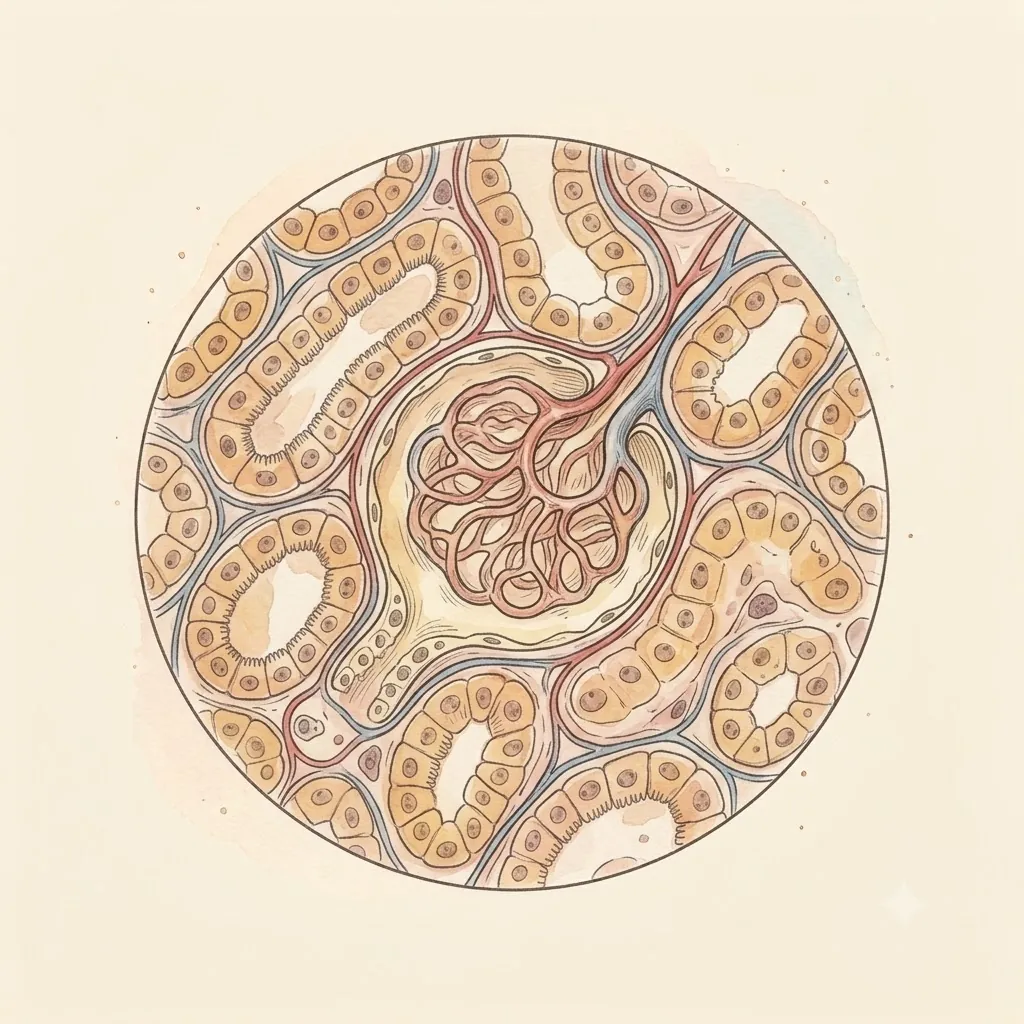 Under the lens
- UreterCarries urine
- HilumThe medial slit everything enters by — vein in front, artery behind it, pelvis behind both
- Superior PoleUpper end, capped by the adrenal gland and reaching the eleventh or twelfth rib
- Inferior PoleLower end, the only part occasionally felt from the front on deep inspiration
- Lateral BorderConvex outer edge; the plane beneath it is Brödel's bloodless line, the way in for a needle
- CalicesMinor calices cup each papilla and merge into two or three major ones
- Pelviureteric JunctionFirst of the three narrowings — where the pelvis funnels down into the ureter
- Crossing of the Iliac VesselsSecond narrowing, at the pelvic brim where the ureter arches over the common iliac artery
Structure
- Renal fascia & fatCushioning that holds the kidney in place against the back wall. It is three wrappings, not one: perirenal fat directly around the capsule, then the anterior and posterior leaves of Gerota's renal fascia enclosing kidney and adrenal together, then pararenal fat behind. The two leaves fuse laterally and above but stay open below, so blood or pus in that compartment tracks down toward the pelvis rather than crossing the midline.
- CapsuleTough fibrous shell; its stretch is what makes obstruction hurt
- CortexOuter zone holding the glomeruli where filtration begins
- MedullaPyramids running a salt gradient that concentrates urine
- PelvisFunnel collecting urine from the pyramids into the ureter
- Sits
- Either side of the spine below the ribs
- Size
- Each is about a computer mouse
- Weight
- 120–170 g each
The lesson
Each kidney is built in concentric zones: an outer cortex where filtration begins, a medulla of pyramids that concentrate urine by running a salt gradient, and a pelvis that funnels the result onward. The real unit of work, the nephron, is too small to see here — but its outcome, roughly a litre or two of urine from 180 litres filtered, is the whole point of the shape.
Throw everything out, then take most of it back
The kidney does not choose what to remove. It pushes a large share of the plasma out of the blood indiscriminately — water, salts, glucose, amino acids, waste, anything small enough to pass — and then spends the whole length of the nephron deciding what to pull back in.
Reclaiming costs far more energy than filtering did.
Wasteful as that sounds, it is what buys reliability. A system that had to recognise every possible waste product would fail on the first unfamiliar molecule.
One that discards everything and reabsorbs only what it recognises handles novel substances by default — which is exactly why kidneys clear drugs they have never encountered before.
Remember
- Filtration is non-selective; all the specificity lives in reabsorption
- Reabsorption is the expensive step and where most renal energy goes
- Discard-then-reclaim deals with unfamiliar molecules automatically
Concentrating urine needs a salty depth
To make urine more concentrated than blood, the kidney needs somewhere saltier than blood for water to move into. It builds that itself.
The loops of Henle pump salt into the surrounding medulla and arrange their flow so each small pumping step is multiplied along the loop’s length, leaving the deep medulla several times saltier than plasma.
The final duct then runs back down through that gradient on its way out, and how much water it lets through is the single adjustable step in the whole system. Antidiuretic hormone opens water channels in the duct wall, water leaves into the salty tissue, and the urine concentrates.
Without the hormone the duct stays watertight and dilute urine passes straight through.
Remember
- The medulla’s salt gradient is built by the loops, not inherited
- Countercurrent flow multiplies a small pumping step along the loop’s length
- One hormone controls one variable: how permeable the collecting duct is to water
It also sets your blood pressure
Filtration only works above a certain pressure, so the kidney has a direct stake in the body’s blood pressure and its own equipment for defending it. When perfusion falls it releases renin, setting off a cascade that constricts vessels and retains salt — pressure restored, filtration resumed.
The same machinery misfires when the shortfall is local rather than whole-body. A kidney sitting behind a narrowed artery reads its own low pressure as a systemic emergency and raises the pressure everywhere to fix a plumbing fault in one organ.
It also makes erythropoietin, the signal to build red cells, which is why long-standing kidney disease reliably brings anaemia with it.
Remember
- Renin defends filtration by raising pressure through the whole body
- One starved kidney can drive body-wide hypertension
- Erythropoietin is made here, so kidney failure causes anaemia
Clinical use
Filters roughly 180 L of fluid
Nephrons fine-tune the chemistry of the bloodstream.
Always read a plate alongside the clinical picture.