Revision sheet
Fertilisation and the first week
From the meeting of two gametes to a blastocyst arriving in the uterus, day by day.
Where the two gametes meet
Fertilisation happens in the ampulla, the widest and most lateral third of the uterine tube — not in the uterus, which is where the embryo only arrives days later. The oocyte survives about 24 hours after ovulation, spermatozoa 3 to 5 days in the female tract, which is what sets the fertile window.
The spermatozoon must first be capacitated: several hours in the female tract strip glycoproteins from its head and make its membrane able to fuse. Only then can it bind the zona pellucida and undergo the acrosome reaction, releasing enzymes that digest a path through it.
- Fertilisation site: ampulla of the uterine tube.
- Capacitation happens in the female tract, never before ejaculation.
- Fertile window ≈ 5 days before ovulation to 1 day after.
Activation and the block to polyspermy
The moment one spermatozoon fuses with the oolemma, a wave of Ca²⁺ crosses the oocyte and the cortical granules empty into the perivitelline space. Their enzymes harden the zona pellucida — the zona reaction — so no second spermatozoon can enter. Polyspermy would give a triploid, non-viable embryo.
The same calcium wave releases the oocyte from its arrest in metaphase II: it completes the second meiotic division and expels the second polar body. The two haploid pronuclei then approach, replicate their DNA, and their chromosomes mingle on the first mitotic spindle.
Fertilisation restores diploidy, determines genetic sex by the sperm's X or Y, and starts the cycle again.
- Cortical reactionzona hardensblock to polyspermy
- The oocyte only finishes meiosis II if it is fertilised.
- The spermatozoon determines genetic sex.
Cleavage
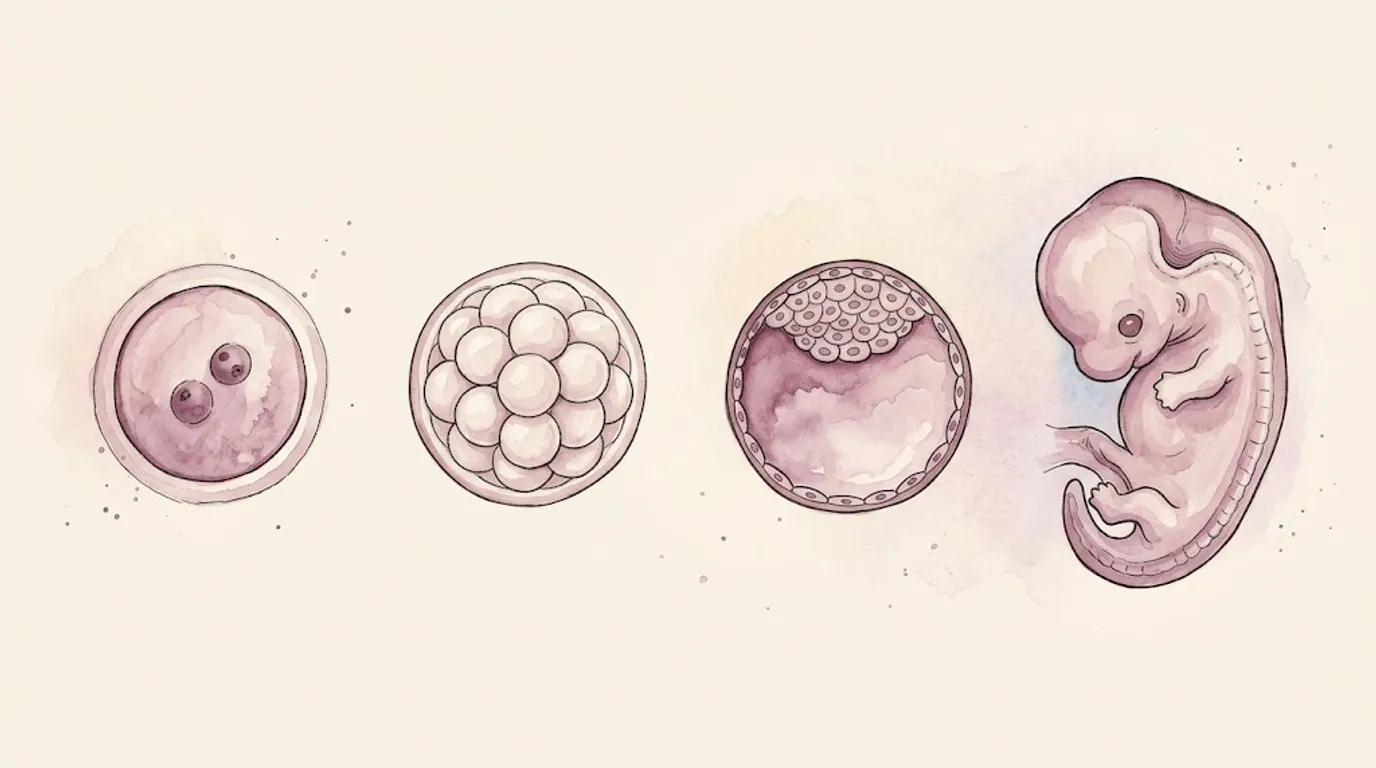
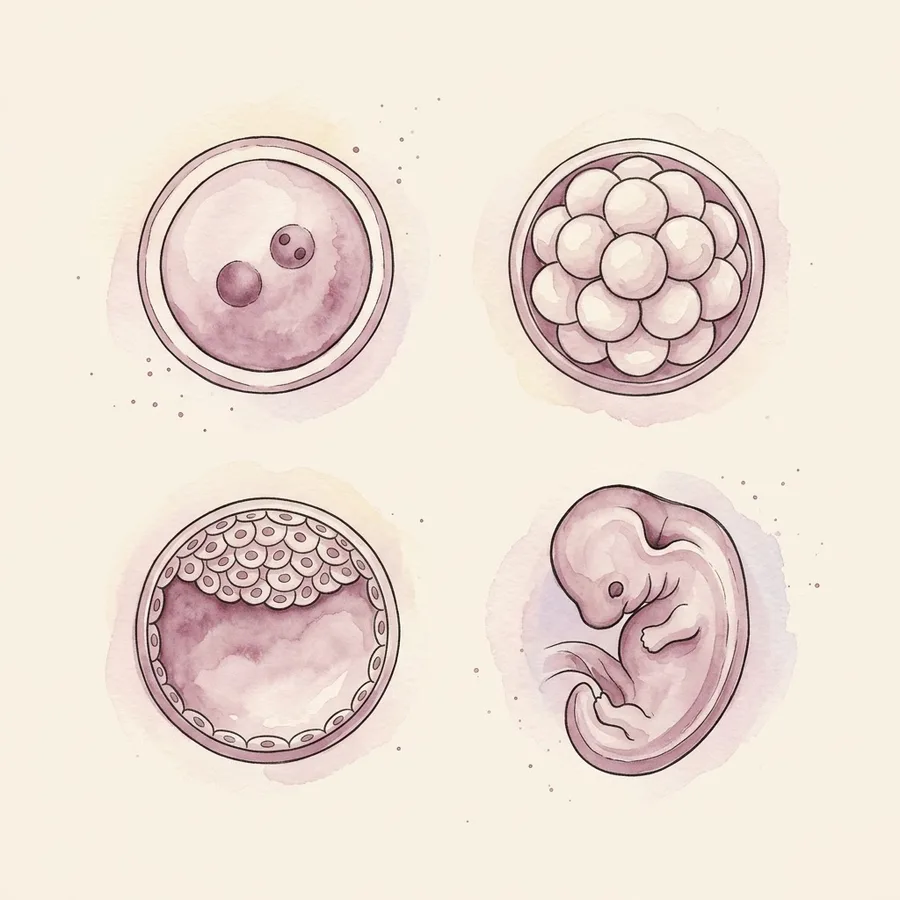
The zygote divides without growing: each cleavage halves the cell size, so the embryo keeps the same overall volume while its cell number rises.
Two cells at about 30 hours, four at 40, and a solid ball of 12 to 16 blastomeres — the morula — by day 3 or 4, still travelling down the tube inside its zona pellucida.
Around the 8-cell stage the blastomeres flatten against one another and form tight junctions, a step called compaction. It is the first time the embryo's cells are no longer interchangeable: the outer ones are becoming trophoblast and the inner ones the embryo proper.
The blastocyst
By day 5 fluid has accumulated inside the morula and pushed its cells into a hollow sphere: the blastocyst. Its wall is the trophoblast, which will build the placenta; a cluster at one pole, the inner cell mass or embryoblast, is what will become the embryo itself.
The blastocyst then hatches from the zona pellucida — it must, since the zona would prevent it sticking to anything — and is free in the uterine cavity by about day 6, ready to implant.
- Trophoblastplacenta. Inner cell massembryo
- Hatching from the zona is the prerequisite for implantation.