Revision sheet
The arches, the dental formula and the four shapes
How many teeth there are, where each sits, and why a tooth's shape tells you what it does.
Two arches, only one of which moves
The teeth are set in two curved rows. The upper arch is carried by the maxilla, which is bolted to the rest of the skull and cannot move; the lower arch is carried by the mandible, the only bone of the face with a joint of its own.
Every act of chewing is therefore the lower arch being driven against a fixed upper one — and every problem of occlusion is a problem of how those two curves meet.
Each arch is divided at the midline, giving four quadrants, and a tooth is named by its quadrant and its position from that midline outward.
The FDI notation used in Tunisian faculties and clinics writes that as two digits: the first is the quadrant, numbered 1 to 4 clockwise from the patient's upper right for permanent teeth and 5 to 8 for deciduous ones, the second is the rank from the midline.
So 11 is the upper right central incisor, 36 the lower left first molar, 75 the lower left second deciduous molar.
- The maxilla is fixed, the mandible moves — chewing is the lower arch driven against the upper.
- Four quadrants, counted outward from the midline.
- FDI: first digit the quadrant (1–4 permanent, 5–8 deciduous), second digit the rank. 36 = lower left first molar.
The dental formula
An adult mouth holds 32 teeth, and the formula is easiest learned as one half-arch, because all four are built the same: two incisors, one canine, two premolars, three molars — eight teeth, multiplied by four quadrants.
A child's mouth holds 20, on a formula that is the same minus the premolars and one molar: two incisors, one canine, two molars, five teeth per quadrant.
The missing premolars are the point worth remembering. A child has no premolar at all, so the deciduous molars sit where the adult's premolars will be, and the permanent molars erupt behind the whole deciduous set rather than replacing anything.
That single fact explains most of what happens between the ages of six and twelve.
- Permanent: 2 incisors, 1 canine, 2 premolars, 3 molars per quadrant = 32.
- Deciduous: 2 incisors, 1 canine, 2 molars per quadrant = 20 — no premolars.
- A deciduous molar is succeeded by a premolar, not by a molar.
Four shapes, four jobs
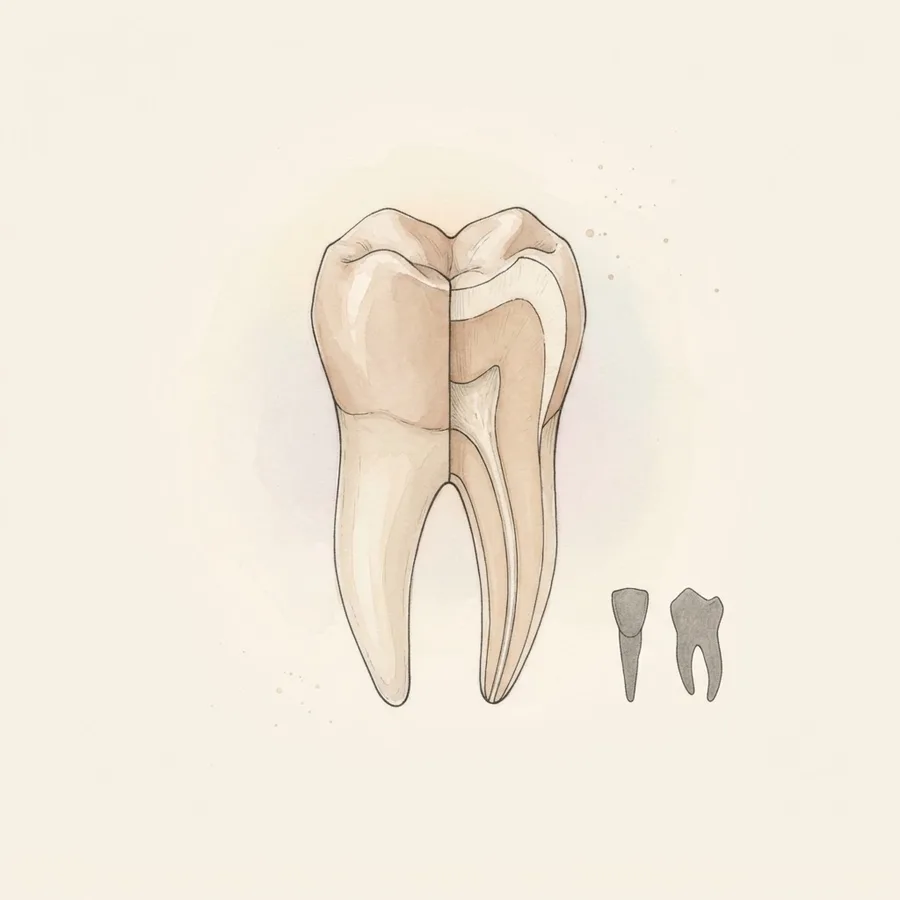
A tooth's crown is a tool, and the four shapes are four ways of breaking food down. An incisor is a chisel: a thin straight edge on a single root, made to cut.
A canine is a cone on the longest root in the mouth, made to pierce and tear, and it anchors the corner of the arch — which is why it is the tooth an orthodontist treats as the cornerstone and the last one a periodontal disease loosens.
Behind them the crowns widen and grow cusps, because the job changes from cutting to crushing. A premolar has two cusps and usually one root, though the upper first premolar commonly has two.
A molar carries the widest crown and four or five cusps, and needs more anchorage to take the load: upper molars have three roots, lower molars two.
Grinding happens at the back for a mechanical reason — the closer to the temporomandibular joint, the shorter the lever arm and the greater the force the same muscle can deliver.
- Incisor cuts, canine tears, premolar crushes, molar grinds.
- Root count rises with load: one for incisors and canines, one or two for premolars, two for lower molars and three for upper molars.
- Bite force is highest at the molars because they sit closest to the joint.
Occlusion, and the muscles that close it
Occlusion is the relationship the two arches hold when the mouth closes.
Normally the upper arch is slightly wider and overlaps the lower both vertically, the overbite, and horizontally, the overjet, and cusps fall into the opposing fossae so that the load is shared across the whole arch rather than borne by two teeth.
Angle's classification reads that relationship off the first permanent molars, which is why that tooth matters out of proportion to its size.
The closing force comes from the muscles of mastication — masseter, temporalis and the two pterygoids — all four supplied by the mandibular division of the trigeminal nerve, because all four are built by the first pharyngeal arch.
They can deliver several hundred newtons at the molars, which is the reason a tooth needs a shock absorber rather than a rigid fixing, and the reason a habit of clenching wears enamel away.
- Normal occlusion spreads load over the whole arch; Angle's classes are read at the first molar.
- Masseter, temporalis and both pterygoids close the jaw, all on the mandibular nerve (V3).
- Bite forces reach several hundred newtons — the tooth is suspended, not cemented rigidly, for that reason.